The Law is an Ass

If the law supposes that,” said Mr. Bumble, squeezing his hat emphatically in both hands, “the law is a ass — a idiot.”
 – Charles Dickens: Oliver Twist –

It would appear that a number of pilots would agree with Mr Bumble (perhaps not in as much as they are unhappy spouses of domineering wives – as Mr Bumble was), but feeling that some laws are applied contrary to common sense.

I find it interesting that the application of law should actually require lawyers, people schooled in law, who could stand in court and argue totally divergent points of view on how the same law should be applied. Often the stated law is interpreted on the intent of the law – clearly an indication that the law is poorly drafted.

Undergrad law students learn that the four principal purposes and functions of the law are establishing standards, maintaining order, resolving disputes, and protecting liberties and rights. The law should be a guidepost for minimally acceptable behaviour in society.

So it should be simple to apply the law, but experience has shown that serial criminals could be absolved and innocent people could become victims of those laws, which should actually protect them. Sometimes the application of the law defies any common sense – perhaps one has to agree with Mr Bumble…

As pilots, we also have to deal with a plethora of laws. While subject to the laws of the land, we are also subject to the various laws as set out in the subdivisions of the Aviation Act. (I’m referring to the South African situation).

The Civil Aviation Technical Standards (CATS) and the Civil Aviation Regulations (CARS) with their many Parts apply in various stages to everything we do in, with and around our aircraft.

In effect, these aviation laws are an extension of the laws of the land and international law setting the guidelines for minimally acceptable behaviour in our society  – and aviation in particular. (We’re back to Law 101 now).

The aviation laws are clear – the interpretation of some laws are perhaps debatable – but the very basic aim is to ensure safety.

However, the laws of nature leave very little space for argument: Newton’s apple will eventually have to succumb to gravity.

Yet we hear daily of pilots defying the laws of nature: overloading aircraft, disregarding density altitudes, flying into adverse weather conditions – the list goes on and on…

Add to this the tendency to feel that “the law is an ass – it doesn’t apply to me, in fact it only applies to others…”.

Here it is instructive to note that in a study overseen by the FAA in an attempt to discover what would make a pilot “accident prone”, they found five common traits in pilots who were prone to having accidents:

  1.  Disdain toward rules.
  2.  High correlation between accidents in their flying records and safety violations in their driving records.
  3. Frequently falling into the personality category of “thrill and adventure seeking”.
  4. Impulsive rather than methodical and disciplined in information gathering and in the speed and selection of actions taken.
  5. Disregard for or under-utilization of outside sources of information, including copilots, flight attendants, flight service personnel, flight instructors and air traffic controllers.

The first trait is probably the most illuminating.

This week I encountered the argument that the skies should be free and that recreational pilots should be left to self-regulate.

I’m afraid that this argument only strengthens the FAA’s first trait of accident prone pilots (above).

The skies would only be “free” if you were the only aircraft around (disregarding your legal obligations to those on the ground and to society), but as soon as two aircraft share the same airspace, some rules need to be applied: Who has right of way, direction of circuits, see-and-avoid, etc.

Whether you regard the law as an ass – or not, please pay heed to what well known flight instructor Rod Machado has to say about aviation law:

“Rules, regulations and SOP’s are symbolic of aviation’s accumulated wisdom. Each one is a historical whisper of errors made, planes lost and limits challenged. Herein lie the posthumous tokens of aviation’s best lessons. They linguistically map out aviation’s hazardous territory. To operate beyond these areas is to thumb our noses at the gods of probability”.
Sully the Movie – A Pilot’s Perspective

“So what did you think of the movie?”

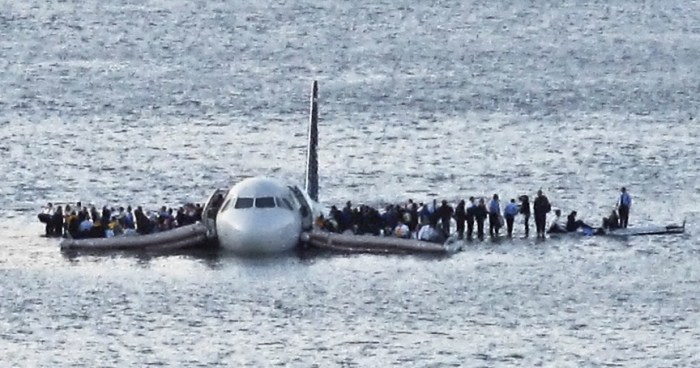
I was immediately faced with that question as I walked out of the screening of Sully, Clint Eastwood’s film about the 2009 landing in the Hudson River, starring Tom Hanks as Captain Chesley “Sully” Sullenberger.

Well, here’s what I think:

Firstly, I thoroughly enjoyed the film for the technical accuracy of the flight and subsequent river landing with very realistic use of CGI. It had to be accurate as so much of the material has already been published. The transcripts of the CVR (Cockpit Voice Recorder)  were already published in Sullenberger’s 2009 book Highest Duty – My Search for What Really Matters, which also told his life story and related the events of the day in great detail.

These CVR recordings lead me to the one aspect I did not appreciate as much – the movie has the CVR played for the first time during the public hearing, while in fact, according to Sullenberger there were only six people present in the audio lab where they first listened to it. But this would not have suited Eastwood’s whole premise for the movie. He built the dramatic edge around the NTSB ruthlessly pursuing Sullenberger and Jeff Skiles, the First Officer (very ably played by Aaron Eckhart). In Eastwood’s mind the NTSB were the bad guys, out to get the good guys – the pilots – who were assumed guilty until proven not guilty.

It bears stating here that any accident investigation by nature is uncompromising. Nothing can simply be assumed and every detail has to be interrogated to arrive at a definitive answer. The objective is not to apportion blame, but to learn and make recommendations to avoid similar events in future.

Sullenberger himself was very clear about the conflict in his own mind – could they possibly have made it back to La Guardia or even Teterboro? Here his whole career of over forty years would be judged on 208 seconds and one decision. I could clearly identify with this self-doubt, something we as professional pilots know well. There is always the nagging worry that something could have been handled better, it is the perfectionist nature of our occupation.

Hanks captures the gravitas of Sullenberger in this situation perfectly. He has proved before that he can deliver empathetic portrayals of men in difficult situations (Apollo 13, Captain Phillips), balancing human frailty with steely resolve.

Sully is a great movie, which caters for a general movie audience who would simply enjoy a rollicking drama of good people conquering adversity. Yet it still satisfies those aviators, who have more than just a passing interest in the dramatic events of January 15th, 2009.

Hopefully the movie will also allow a glimpse into how seriously professional pilots take their occupation – Hanks’s Sullenberger provides the ideal example. His one decision on that day led to 155 souls surviving a dual engine failure and a subsequent forced water landing – pilots daily make hundreds of decisions with less dramatic impact, but which directly affects the lives of passengers worldwide.

Go and see the movie!


Royal Aeronautical Society | Insight Blog | Lives before luggage

I have posted a number of blogs regarding passengers’ apparent disregard for their own safety. As valuable additional reading, here is an insightful blog about evacuations from the RAeS:

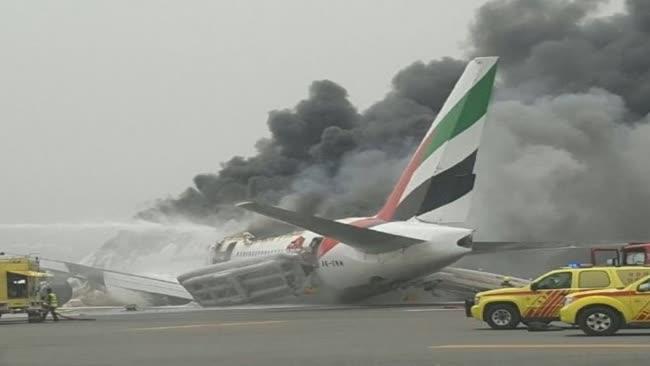
During the recent emergency evacuation of the Emirates 777 which caught fire in Dubai, a number of passengers endangered their safety and those of others by stopping to collect their luggage. BILL READ FRAeS looks at some of the ideas being proposed to prevent such actions reoccurring and how it may be time for a rethink of the regulations governing aircraft emergency evacuations.

Source: Royal Aeronautical Society | Insight Blog | Lives before luggage

Leave Everything Behind! (Exit before Tweeting…)

Yesterday we witnessed the crash of an Emirates B773 at Dubai. I use the word “witnessed” as we may just as well have been eyewitnesses, what with visuals instantly available on the major TV channels, uploaded from social media. Had it happened a few years ago, we would simply not have had access to these dramatic visuals captured by actual eyewitnesses.

(See my previous blogs on the emergency and social media aspects of this phenomenon: Evacuate! Evacuate! Are you ready? and Beware the Jabberwock, my son! ).

What I find disturbing though, are the visuals recorded by passengers during the actual evacuation of EK521, with a life-threatening emergency in full swing:
Pax Evacuation EK521

During many previous aircraft emergencies we’ve witnessed this behaviour before: Cell’phones on, visuals recorded and instantly shared on social media. Allow me to be blunt: This type of behaviour deserves a Darwin Award for Deadly Stupidity!

It would appear that in aviation we’re not alone in this:

1013_in-case-of-fire-exit-building-before-tweeting-about-it_543-720
Pic: socialsmiling.com


So what allows us to exhibit this kind of stupidity? What level of intelligence would allow a normally stable individual to jeopardize not only his/her own life, but the lives of others as well?

I can only assume that it is the same level of intelligence which would allow passengers to blatantly disregard the safety regulations, ignore safety briefings and refuse to obey lawful instructions regarding electronic devices.

The bottom line is that anything which could distract one during an emergency should be avoided at all costs – hence the announcement by cabin crew regarding no cell’phones or headphones before departure or arrival. When the fire is at your heels and the smoke is choking you, that is not the time to worry about your branded hand luggage or your personal effects – that is when saving lives should be your one and only concern.

I know that passenger safety is our single-minded concern. As professional air crew we’ll do everything possible to ensure that, but passengers also have a role to play in their own safety!

However, it would appear that any commonsense, reason and responsibility is zipped up and stowed in the luggage when passengers check in….


Why Are You Late!

The best-laid schemes o’ mice an’ men
Gang aft agley,
An’ lae’e us nought but grief an’ pain,
For promis’d joy!
Robert Burns – From: ” To a Mouse, on turning up in her nest with the plough”.

We’re running late.

In fact, we haven’t even signed on yet – my four sectors rostered for today have been delayed – and I’m already working on what apologies we’ll have to come up with to calm our disgruntled passengers….

Late

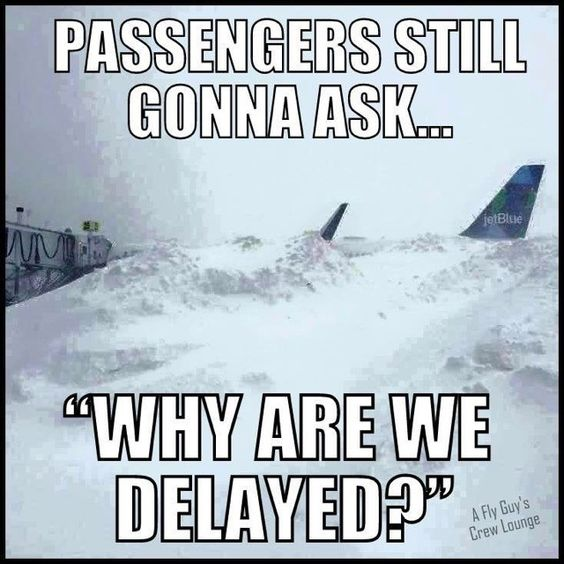
The reason today is the knock-on effect of the icy conditions at another airport this morning – the early flights had to wait for the sun to melt ice off the wings. Fortunately we don’t have snowstorms (as in the picture above) in South Africa, but we do find temperatures falling to below zero in winter. Add a little moisture and then you could find contamination on the wings – which, if untreated, we well know the results of. Air Florida Flight 90 is but one example. As we don’t suffer from surface icing too often, we do not have de-icing facilities at any South African airports. Sunshine is our only salvation!

So here we sit after a night stop, waiting for our delayed aircraft to arrive to continue our (delayed) eight-sector pairing.

But that is scant comfort for our passengers who feel that they are entitled to an on-time departure and arrival.

Weather is only one of the many reasons leading to flight delays. In SA thunderstorms are usually the culprits during summer; sometimes driving rain or fog results in go-arounds and diversions from airports with only CAT I or visual approaches. Many times the crosswind component is simply out of limits, ruling out an approach or necessitating a go-around.

From our side its often because of an aircraft developing a technical problem, which, if it can be repaired on the line could result in a short delay of up to an hour. Some snags take more time, especially if specific spares or tools are required – if the aircraft is grounded, schedules have to be adjusted to find other aircraft to pick up the slack, often resulting in all of us kicking our heels for frustrating periods of time.

Often such delays can lead to crews running out of flight and duty time, which legally necessitates later sign-on times for those who night stop at out stations. You should hear the chirps from furious passengers when we finally show up to operate such a flight – very thick skins are required! Explaining the safety aspect usually does not help much – I sometimes get the impression that passengers would rather depart unsafely, as long as it’s on time..

Sometimes the passengers are to blame – my pet hate is passengers who check in (with luggage) and then disappear between the counters and the gates. Its like socks – where the hell do they get to? Now we have to search for their loaded bags, inevitably the very last ones to be found.

Arriving with too many bags also delays us, as those simply cannot fit in a full cabin and have to be carried downstairs to be loaded in the hold (usually after a heated argument..)

Some passengers are like hens arranging nests – why can’t they simply move in, and sit down? While passengers are standing around, going to the toilet or repacking their cases, we cannot close the doors. Late yet again.

Many other reasons can be trotted out for delays. The bottom line, however, is that a delay is only that: A delay. It is not a disaster and it is not the end of the world!

Our airline aims for a minimum target of 85% on-time departures (on time is defined as leaving within 15 minutes of the scheduled departure time) and has achieved that for six consecutive months now.

After all – A safe flight and safely arriving at your intended destination is more important than fretting about a delay.