The Romance of Late Nights

(Originally published in FMR’s Opus Magazine, September 2024).

A pilot’s business is with the wind, and with the stars, with night, with sand, with the sea. He strives to outwit the forces of nature. He stares with expectancy for the coming of the dawn the way a gardener awaits the coming of spring. He looks forward to port as a promised land, and truth for him is what lives in the stars.
                                                               Antoine de Saint-Exupery

Two authors (both pilots) should be prescribed for any aviator’s must-read list. Antoine de Saint Exupery is one, especially for his Night Flight and Sand, Wind and Stars.

The other is Ernest K Gann – with a library list of his own, headed by Fate is the Hunter. Oh, and I must add the best read for helicopter pilots – Robert Mason’s Chicken Hawk, his memoir of flying Hueys during the Vietnam conflict.

But back to De Saint Exupery and Night Flight: Flying at night is special. Many were the nights I spent counting passing satellites and flaming meteors streaking across the sky, marvelling at the absolute clarity of the Milky Way from our dark cockpit at forty-one thousand feet. Wondering whose little light would still be twinkling down there in the dark expanse of the African continent, being awestruck by the magnificence of a summer thunderstorm illuminating the massive thunderheads – the memories are many, reminding me of a quote by Adolf Galland: “Flying is more than a sport and more than a job; flying is pure passion and desire, which fill a lifetime.”
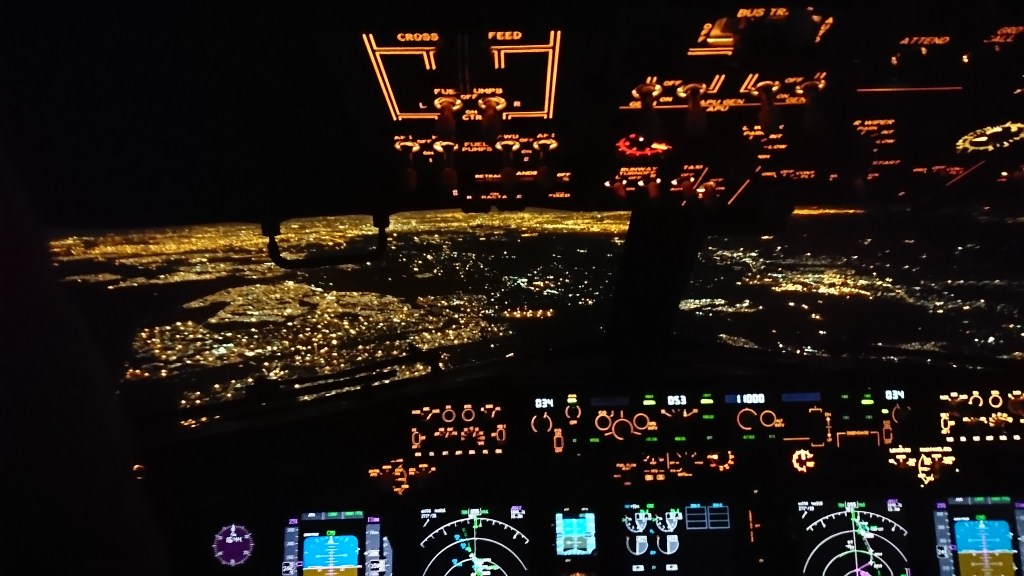
On the descent for a late night approach into Johannesburg, South Africa.

That quote could be moved directly to the field we occupy ourselves with – radio and broadcasting, “pure passion and desire, which fill a lifetime.”

Traditionally, the late-night slots were where you let the inexperienced new presenters loose – most of us who started out in professional radio cut our teeth on some late-night shows. At FMR we are fortunate to have some very capable late-night presenters, among them some exciting young talents. Give them a listen – Shireen Fisher, Siphiwo Deke and Andrew Williams, who present late-night jazz on Fridays, Saturdays and Sundays from nine until midnight. During the week we have some experienced voices on air late at night – Penelope, Graham McCulloch, Dragana Jevtovic, Saan Mahomed – all stalwarts and music experts.

It reminds me of The Nightfly, Donald Fagen’s first solo album from 1982 (just after Steely Dan had disbanded). Amongst other topics Fagen sang about late-night jazz disc jockeys. It became a bit of a cult album for those of us on air in those days!

A radio studio late at night is a special place – intimate, lights low and especially with FMR simply the best music around. Situated in Artscape’s Marble Foyer, our studio has the added advantage that you can see the crowds attending shows, and they can see you.

When next you’re driving home after a show or relaxing late at night – FMR is still your best companion. Your favourite music, on your favourite station, presented by passionate radio people. Late at night it doesn’t get better than that.
Steinbeck and the Delicacy of Coordination.

(Originally published in FMR’s Opus Magazine, August 2024).

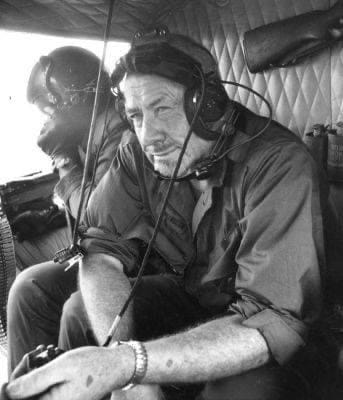
The American author John Steinbeck was 65 in 1967, when at the behest of Newsday magazine, he went to Vietnam to report on the war. (Steinbeck had received the Nobel prize for Literature in 1962). Alicia Patterson’s friend since 1956, he wrote a series of articles in the form of “Letters to Alicia” for Newsday following her death. At Pleiku, he flew aboard a UH-1 Huey helicopter with D Troop, 1st Squadron, 10th Cavalry, and wrote about the helicopter pilots:

“I wish I could tell you about these pilots. They make me sick with envy. They ride their vehicles the way a man controls a fine, well-trained quarter horse. They weave along stream beds, rise like swallows to clear trees, they turn and twist and dip like swifts in the evening. I watch their hands and feet on the controls, the delicacy of the coordination reminds me of the sure and seeming slow hands of (Pablo) Casals on the cello. They are truly musicians’ hands and they play their controls like music and they dance them like ballerinas and they make me jealous because I want so much to do it. Remember your child night dream of perfect flight free and wonderful? It’s like that, and sadly I know I never can. My hands are too old and forgetful to take orders from the command center, which speaks of updrafts and side winds, of drift and shift, or ground fire indicated by a tiny puff or flash, or a hit and all these commands must be obeyed by the musician’s hands instantly and automatically. I must take my longing out in admiration and the joy of seeing it”.

Knowing of Steinbeck’s love of music, I’m not surprised at his musical description of the pilots’ control. I do think many of the pilots (barely out of their teens) would have been surprised at the comparison, though.

Flying helicopters demands very fine coordination – left hand handling the collective and throttle, plus radios and switches, right hand unable to leave the cyclic with its tiny movements and many switches, and the anti-torque pedals requiring constant inputs to counter the helicopter’s natural wish to pirouette around its own vertical axis.

Watching the finalists in our FMR Bursary Trust Music Awards concerts on the 23rd and 26th July, I was reminded of Steinbeck’s description – the “delicacy of the coordination”.


The cello, the clarinet, the piano, the guitar, the uhadi or xylophone – all demanding total concentration, full commitment, and that delicate coordination. Resulting in the beautiful music we were treated to.

Four categories, Classical Instrumental and classical vocal on the Tuesday, and African Music and Jazz on the Friday again gave us an assurance that the future of our music is in good, coordinated hands.

Demanding a cerebral dexterity of another kind is the art of the wordsmith. Steinbeck may have achieved international recognition, but so has our own Amanda Botha, who wrote about opera and ballet for an international publication for many years, and last year they gifted her six weeks in New York to see some productions. A journalist since the late ‘Sixties, publicist for Afrikaans theatre and Opera, published author, acclaimed art curator – those are only some of her accomplishments – and, for the past 15 years, editor of FMR’s programme Boekkeuse. The vast amount of work this demanded was simply astonishing, but Amanda soldiered on – always smiling and always humble.

And now Amanda has decided to call it a day, and step back from the unrelenting demands of live radio at the end of August. She leaves a legacy, and the FMR family will miss her dearly.

We wish Amanda a well deserved rest, but knowing her, she’ll keep busy with her many other projects. We salute her.

Van almal by FMR – Baie, baie dankie Amanda. Mooi Loop!

The Art of the Understatement.

(Originally published in FMR’s Opus Magazine, June 2024).

By the time you receive this edition of Opus, the cacophony of mudslinging and empty promises we experienced during the May elections should be fading out. All the noise and hot air we had to endure, set me thinking about the value of FMR to our communal psyche – especially with our 29th birthday coming up soon.

But first, my obligatory flying story:

Legendary pilot, educator and adventurer Dick Rutan died early in May this year. He was 85. Rutan was probably best known for the record-setting nonstop (without refuelling) circumnavigation of the earth he and Jeana Yeager accomplished in 1986. This in a strange-looking aircraft with two small piston engines, designed by his brother, maverick aircraft designer Burt Rutan.

A highly decorated Vietnam veteran, Dick Rutan flew 325 combat missions and was awarded the Silver Star, the Purple Heart, the Air Medal with three silver oak leaf clusters, the Collier Trophy and was also awarded the Distinguished Flying Cross – twice. These decorations are not dished out by Uncle Sam for just showing up.

I had the honour of meeting Dick Rutan and Jeana Yeager (not related to the famous Chuck Yeager), when they visited South Africa during the late eighties as guests of the Aero Club of SA. I interviewed them on morning TV. Knowing of his wartime exploits and achievements, I asked Rutan what he would consider as the most dangerous thing he had done in Vietnam. His answer: “Walking into a bar in Saigon…”

Dick Rutan, whose round-the-world flight made history, dies at 85 - The  Washington Post
Dick Rutan and Jeana Yeager after their record breaking flight. (Image: Washington Post).

This very quickly made me realise that he was not going to be questioned in public about his combat experiences, and it also taught me about the power of understatement.

Sometimes less is indeed more. When I started out as a young broadcaster, one of my mentors was the legendary Robin Alexander. Although he could talk the hind leg off a donkey as “Minister of Midnight Affairs”, his mantra was always: “If you have nothing to say, don’t say it”. That bit of sage advice has stuck with me throughout the years, and through my many career deviations.

During the recent election campaigns in our country, with lots of bombast saying absolutely nothing, I was often reminded of Robin’s advice again.

What he tried to convey, was that you should never start talking, without knowing exactly why, how, and for how long you’re going to have that microphone fader open. It is still the best advice I can offer our presenters today.

I believe that we are listening to FMR, because of the distinct absence of talk-for-the-sake-of-talk, and rather for our music. The founders of Fine Music Radio had the wisdom to apply for a broadcast license, which today still stipulates 90% music and 10% talk. This allows our presenters to weave a gentle background of valid information around the playlist, without bombarding us with the frustrating chatter and inane comments found on most other radio stations.

Where we do have talk, our programmes are geared to serve our “community of interest” as defined in our broadcast license, and to promote all our communities’ activities in the performing, visual and literary arts.

That is why we believe that our promise of “calm in chaos” is even more relevant today, than when FMR first hit the airwaves 29 years ago. While the hoo-hah around 30 years of democracy recedes into the history books, FMR quietly and calmly soldiers on, to next year celebrate 30 years of playing the world’s most beautiful music – understated, and with your support, against the odds.

Nobody should die in an aircraft during peacetime…

That’s a quote we often use during CRM training.

For a number of years most airline pilots used to be former Air Force pilots. Many of whom managed a seamless and successful transition to civilian flying. The numbers of ex-military civilian pilots may have dwindled, but many still make that transition.

During two decades of Human Factors training, I have also encountered the military “mission attitude” – and spent many hours explaining that an airline schedule does not have to be kept at all costs!

Jay Rayner’s book “Stardust Falling” is a very worthwhile read, telling the sad story of a military mindset, which killed too many innocent civilians.

Fortunately, aviation has come a long way since those postwar days – when the Captain’s word was treated as Gospel.

I can recommend this article from Flight Safety Australia, which looks at Bennet’s unfortunate, unenviable and simply sad history.

The Time has Come

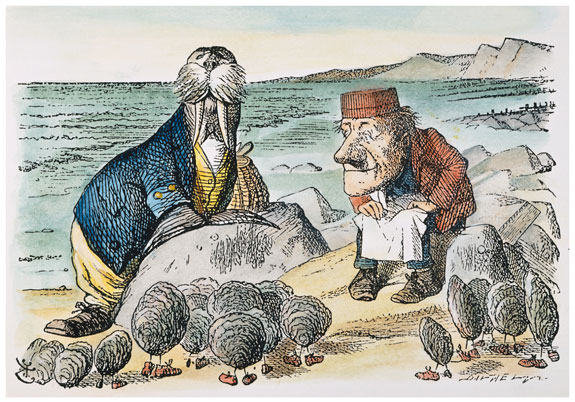
The time has come,' the Walrus said,
To talk of many things:
Of shoes — and ships — and sealing-wax —
Of cabbages — and kings —
And why the sea is boiling hot —
And whether pigs have wings.'
        (The Walrus and the Carpenter – Lewis Carroll)

Life is all about choices – so the old cliché goes. One could choose life as a self-determined destiny, or as a predestined, no-control condition – or as a condition and conclusion decided by others. This external control choice is what the poor oysters who ended up on the buttered bread had exercised. (Carroll’s poem, from “Through the Looking Glass” speaks about a walrus and a carpenter who trick innocent young oysters and eat them after a walk on the seashore).

However, the human condition is inexorably linked to the inevitable passage of time. One of the benefits of this countdown, is that with age comes experience and (hopefully) some wisdom. In Carroll’s poem the eldest oyster decided not to follow, while the younger ones went off to meet their doom…

So, how important is age? Popular literature portrays age as “just a number”, but in flying, unlike most other occupations, the decision about when you should be put out to pasture is not your own. A preset age, arbitrarily determined by regulators (presumably with some input from actuaries quoting statistics) renders one quite suddenly incapable of commanding an airliner. This after a pilot has twice a year, for many years, proved his or her capability to regulator and airline, flew the line without mishap and could still pass a Class 1 medical without any problems.

However, where the young oysters could not foresee the end, at least pilots are pre-warned and thus prepared for the event.

Just not this time…

Suffice to say that COVID-19 has decimated the aviation industry, and all too many articles have already been written about it.

Qantas chief executive Alan Joyce described it as ‘the worst crisis the aviation industry has gone through’. United Airlines chief executive Oscar Munoz has called it ‘the most disruptive global crisis in the history of aviation’.

Around the world, 22 major airlines have gone into bankruptcy or administration. Manufacturers and operators including Airbus, Rolls-Royce, British Airways, Ryanair and Qantas announced job cuts totalling tens of thousands. Fortune magazine estimated 670,000 aviation jobs had disappeared by June 2020. With 92 per cent of its fleet on the ground, Lufthansa put 80,000 of its 130,000 workforce on shortened hours.

The International Air Transport Association (IATA) says air transport is likely to witness a dive in revenue of 55 per cent in 2020 compared to 2019. IATA expects the resulting slump to lead to 32 million job losses

Worldwide, many pilots are retiring early or accepting severance packages. Many more are simply leaving the industry, possibly never to return – pilots possess many interchangeable skills which could be used in miriads of other fields.

Some have had the misfortune of living with no pay during lockdown, now possibly returning to fly a reduced schedule for a shrinking airline and with severely reduced remuneration packages.

Others suddenly found themselves out in the cold – having reached that disqualifying age during the pandemic. Months without income suddenly followed by “retirement”.

“Not too bad”, I hear you say – and you’re correct. It is indeed better than many others’ circumstances. But is is still sad for senior pilots not to have any say in the matter, not to have had the planned run-up to the final flight and the goodbyes.

For those of that certain age it becomes a case of dealing with retirement investments and financial advisors – who all resemble the walrus and the carpenter – presenting a rosy picture while planning to have you on buttered bread…

The eldest Oyster looked at him,
But never a word he said;
The eldest Oyster winked his eye,
And shook his heavy head—
Meaning to say he did not choose
To leave the oyster-bed.

Forty years of flying have taught me this: Given the time and thought required, the storm will clear and the emergency can be resolved. And it requires the patience and resilience of the eldest oyster.

Just like this oyster – who remained put – the secret is to await the next high tide. That high tide will inevitably arrive, recede and arrive again. With it will come the vision of fresh waves to wash away the grit and sand, providing new nutrients and yet another opportunity to grow.

The time has come, to talk of many things… and about where to next.