The Time has Come

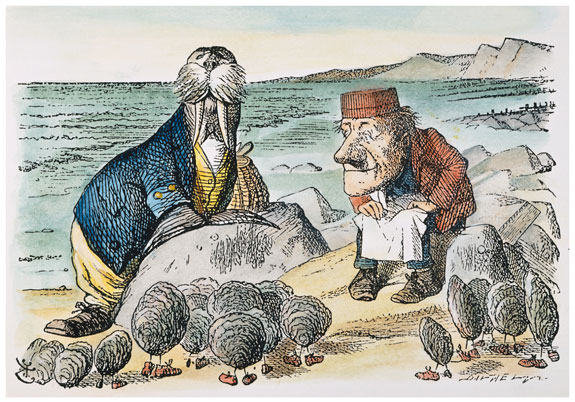
The time has come,' the Walrus said,
To talk of many things:
Of shoes — and ships — and sealing-wax —
Of cabbages — and kings —
And why the sea is boiling hot —
And whether pigs have wings.'
        (The Walrus and the Carpenter – Lewis Carroll)

Life is all about choices – so the old cliché goes. One could choose life as a self-determined destiny, or as a predestined, no-control condition – or as a condition and conclusion decided by others. This external control choice is what the poor oysters who ended up on the buttered bread had exercised. (Carroll’s poem, from “Through the Looking Glass” speaks about a walrus and a carpenter who trick innocent young oysters and eat them after a walk on the seashore).

However, the human condition is inexorably linked to the inevitable passage of time. One of the benefits of this countdown, is that with age comes experience and (hopefully) some wisdom. In Carroll’s poem the eldest oyster decided not to follow, while the younger ones went off to meet their doom…

So, how important is age? Popular literature portrays age as “just a number”, but in flying, unlike most other occupations, the decision about when you should be put out to pasture is not your own. A preset age, arbitrarily determined by regulators (presumably with some input from actuaries quoting statistics) renders one quite suddenly incapable of commanding an airliner. This after a pilot has twice a year, for many years, proved his or her capability to regulator and airline, flew the line without mishap and could still pass a Class 1 medical without any problems.

However, where the young oysters could not foresee the end, at least pilots are pre-warned and thus prepared for the event.

Just not this time…

Suffice to say that COVID-19 has decimated the aviation industry, and all too many articles have already been written about it.

Qantas chief executive Alan Joyce described it as ‘the worst crisis the aviation industry has gone through’. United Airlines chief executive Oscar Munoz has called it ‘the most disruptive global crisis in the history of aviation’.

Around the world, 22 major airlines have gone into bankruptcy or administration. Manufacturers and operators including Airbus, Rolls-Royce, British Airways, Ryanair and Qantas announced job cuts totalling tens of thousands. Fortune magazine estimated 670,000 aviation jobs had disappeared by June 2020. With 92 per cent of its fleet on the ground, Lufthansa put 80,000 of its 130,000 workforce on shortened hours.

The International Air Transport Association (IATA) says air transport is likely to witness a dive in revenue of 55 per cent in 2020 compared to 2019. IATA expects the resulting slump to lead to 32 million job losses

Worldwide, many pilots are retiring early or accepting severance packages. Many more are simply leaving the industry, possibly never to return – pilots possess many interchangeable skills which could be used in miriads of other fields.

Some have had the misfortune of living with no pay during lockdown, now possibly returning to fly a reduced schedule for a shrinking airline and with severely reduced remuneration packages.

Others suddenly found themselves out in the cold – having reached that disqualifying age during the pandemic. Months without income suddenly followed by “retirement”.

“Not too bad”, I hear you say – and you’re correct. It is indeed better than many others’ circumstances. But is is still sad for senior pilots not to have any say in the matter, not to have had the planned run-up to the final flight and the goodbyes.

For those of that certain age it becomes a case of dealing with retirement investments and financial advisors – who all resemble the walrus and the carpenter – presenting a rosy picture while planning to have you on buttered bread…

The eldest Oyster looked at him,
But never a word he said;
The eldest Oyster winked his eye,
And shook his heavy head—
Meaning to say he did not choose
To leave the oyster-bed.

Forty years of flying have taught me this: Given the time and thought required, the storm will clear and the emergency can be resolved. And it requires the patience and resilience of the eldest oyster.

Just like this oyster – who remained put – the secret is to await the next high tide. That high tide will inevitably arrive, recede and arrive again. With it will come the vision of fresh waves to wash away the grit and sand, providing new nutrients and yet another opportunity to grow.

The time has come, to talk of many things… and about where to next.
100 Days and Counting.

Last time I was counting down at 50 days, and here we are past 100 days – still under lockdown, albeit with the somewhat more accommodating regulations of Level 3.

As discussed in my last blog, we are indeed now seeing a return to flying. It may be much reduced and restricted, but at least there is some movement. Many industry experts and organisations have speculated on just how long it would take for commercial aviation to recover, but rather than commit to forecasts, I will adopt a wait and see attitude. I’m reminded of Warren Buffet’s quip: “Forecasts may tell you a great deal about the forecaster, they tell you nothing about the future”.

What caught my attention during this period are peoples’ attitudes about the COVID-19 pandemic. One only has to look at social media posts to witness the stupid and boorish behaviour of many citizens around the world – the woman throwing groceries around or the man shouting abuse at shop assistants – instances where the issue was their refusal to wear masks, despite the clear rules at shop entrances stating “No mask – No Entry”.

Psychologists are quick to point out the reasons for such behaviour – just Google the psychological reasons for not wearing masks: You’ll be inundated with reasons ranging from denial to feeling powerless to political influence, mixed messages and psychotic or sociopathic behaviour.

All fair and well, but how are we dealing with the current situation in aviation?

Face facts, being a pilot currently is not a great occupation. All over the world airlines are laying off pilots – Emirates, Delta, Qantas, Air France, Air Mauritius – you name them, pilots are out of work everywhere. Expats are stuck with borders closed, households suddenly have no income – the situation is dire.

Now, to paraphrase Warren Buffet’s quote: Handling of a crisis will tell you more about the pilot than about the outcome.

I recently read a blog by pilot and author, Owen Zupp, who was laid off by Qantas (read HERE). While the business world and twitter experts are sprouting forth about resilience, here is a quiet example. Similarly, I recently met with a fellow Captain who had to sell his house, because they couldn’t keep up the bond repayments – yet this was done with almost stoic acceptance, dealing with the situation at hand in the most reasonable way. Just by way of explanation, crews in my company (as in many others) have been on unpaid leave since the beginning of lockdown. With no profitable flying possible for the foreseeable future, with licenses and currency now lapsed, it means proper crisis management to simply survive.

Shouting and screaming has never solved any problem – and professional pilots are trained to deal with crisis situations methodically and logically.

Thus  I found a recent webinar for GA pilots rather disconcerting.

While other people are dealing with life-and-death situations, some private pilots (and, sorry to say, some career pilots too) exhibited the same selfish and negative behaviour we see in the social media posts referred to earlier. Flaunting laws and regulations, threatening civil disobedience, using foul language – these are not traits one would expect of pilots behaving professionally. Abusing the hard-working volunteers, who actively are engaging with the CAA and other relevant departments to achieve the phased opening of recreational and sport aviation, while clearly showing a lack of knowledge and procedures, being totally ignorant of where to find NOTAMs and other relevant information – frankly, it leads me to question whether people exhibiting these negative behaviours should be allowed near an aircraft at all! .

Here we see some of the well known hazardous attitudes:

  • Anti-authority,
  • Impulsivity,
  • Invulnerability,
  • Macho, and
  • Resignation,
  • most obviously the anti-authority, invulnerability and macho attitudes.

These attitudes simply do not belong in a safe aviation environment. That is why highly experienced airline pilots now have to undergo three days of ground school and two days of simulator training before being allowed near an airliner – because they understand the associated risks and know that regulations and SOP’s are there for a reason.

Should one find regulations unreasonable or illogical, there are professional ways to bring about change. Until such time, professionals follow the rules.

I’m one of the very happy motor racing fans who are watching the first actual 2020 Grand Prix this weekend. Aviation can take a leaf from the F1 book on how to deal with the epidemic – essentially follow the published rules or you simply won’t be allowed near the track.

Simon Lazenby, Jenson Button and Martin Brundle social distancing while commentating on the Austrian GP qualifying.

The potential risks associated with not adhering to the rules for the new reality are just too great for this multi-million dollar sport – so no deviance is tolerated. And in F1 we are also dealing with strong A-type personalities, so no excuses for aviation!


50 Days and Counting

“I’m gonna give you Forty Days” sang Cliff Richard all those years ago. But we have not made it back yet – and forty days have come and gone.

Cliff

Fifty days – that’s how long we’ve now been under lockdown in South Africa.

For aircrew this could spell a multitude of problems, not least of which is the fact that most pilots and cabin crew are currently on unpaid leave. This loss of income has severe ramifications for many and it cannot be sustained for much longer.

That aside – despite the SACAA’s extension of licenses and ratings to the end of June, other implications could be as severe.

Among these is the requirement for recency and currency –  some airlines require a check-flight after 30 days without flying. Problem is, check-captains and instructors need the same, so they would have to regain currency in the simulator before doing any check-flying.

This may not be as easy as it sounds – we currently have no idea when flying will be allowed again and at what level. We can only assume that moving to Level 3 restrictions would allow for training and very restricted flights. But, should the nightly 20h00 – 05h00 curfew remain in place, (which appears to be the case under Level 3 restrictions), just imagine trying to schedule all training only during daylight hours – bearing in mind travel time before and after such simulator sessions. For airlines without their own simulators, finding and hiring time on simulators may initially be almost impossible – potentially delaying their return to training. Remember that the closed borders currently restrict international travel, which means that only local simulators (of which there are not that many) may be available.

Hopefully the restrictions on flying and flight training will not last another 40 days, at which stage the 90 day recency and currency regulations would mean that every airline pilot would have to do a simulator session before even touching an aircraft.

When we finally do start flying, albeit limited in frequency and routes, stored aircaft would have to be brought out of mothballs, checked, signed out and possibly test flown before doing any commercial flights. This could turn into a lengthy process.

Looking at IATA’s projections for the recovery of commercial aviation, we’re in for a long and slow recovery.

Interestingly enough, IATA proposes that social distancing would be impossible on aircraft. While we know that aircraft aircon systems use HEPA filters, which are similar to those used in hospital operating theatres, it appears that the travelling public is quite suspicious of its efficiency.

What is clear is that for the foreseeable future airline flying will never be the same again.

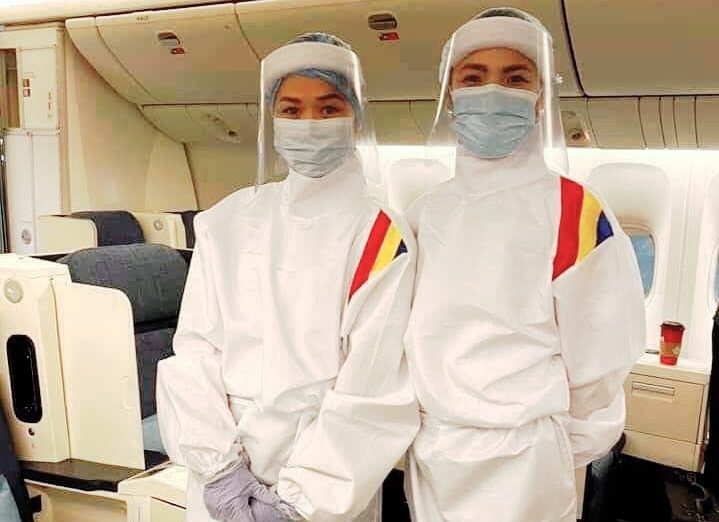
Sanitising and deep cleaning between flights will become routine, adding time and costs. Wearing of face-masks in airports and on aircraft may become compulsory – crews may look like ICU nurses.

PPE
Phillipines cabin crew in their designer PPE wear.

During flight, passengers’ movement could be restricted – you may well have to “reserve a slot” to use the toilet…

Catering could be another no-no, especially on shorter flights – locally the longest flights are only two hours in duration. On longer flights catering could be pre-packaged and sealed – fancy first-class fare could well be a thing of the past.

Eventually it would boil down to passengers being adult and taking responsibility for their own protection and health.

As for how – and more importantly, when we can expect to get airborne again – the mixed and opaque messages from goverment are not particularly helpful in this regard.

Play it by ear is the only song on our current aviation hit parade – and we’re in it for The long Run!


Machines or Pilots?

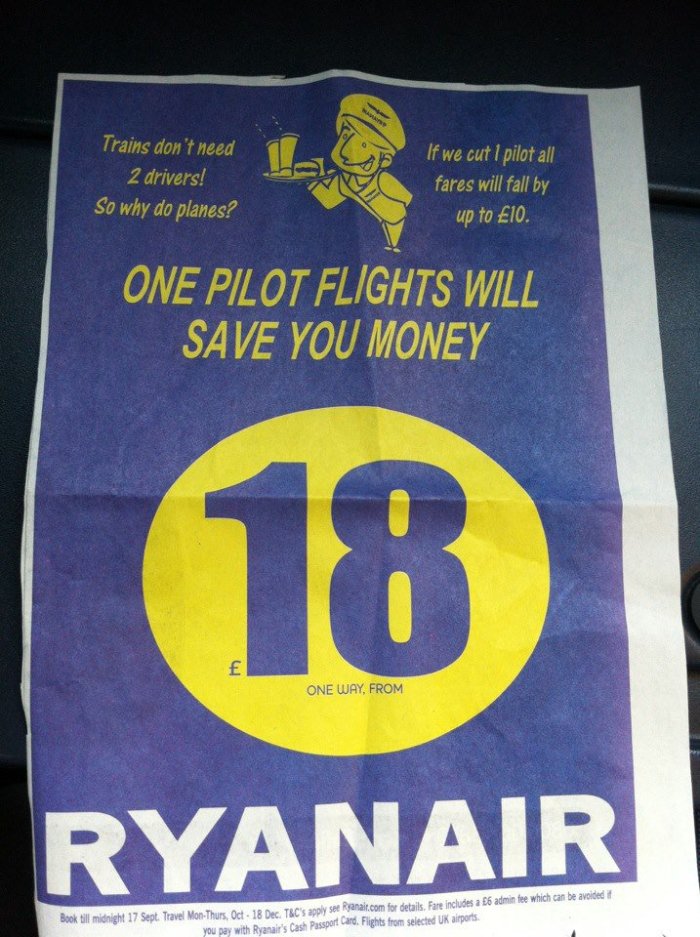
I don’t know how genuine the featured Ryanair advert is – it could well be “fake news” – but it does fit the cost-cutting image of Michael O’Leary! He has long advocated that he wanted single-pilot airliners by 2020, as well as advocating “stand-up” cabins (no seats) and passengers paying to use the toilets. A lot of this is usually dismissed as publicity stunts, but his recent stand-off with pilot unions clearly indicates that a no-pilot airline would be his ideal. It is quite enlightening to hear him contradicting himself about the importance of pilots: https://youtu.be/fSmnHbGMMok

He is not alone.

Research into autonomous flight is well underway. Boeing’s research has been underway since 2013 and Airbus has been working with French aerospace research company Onera and avionics manufacturer Thales for a number of years now.

The financial impetus to move to pilotless aircraft is immense – analysts see a potential profit opportunity worth about $35 billion for the aviation and aerospace manufacturing sectors. Read more here: http://aviationweek.com/commercial-aviation/pilotless-commercial-aircraft-follow-money

Artificial Intelligence has already surpassed human ability – just research Google’s AlphaZero programme, which defeated Stockfish 8, a programme capable of calculating 70 million chess positions per second. AlphaZero, though, was not programmed or taught any chess at all. It taught itself to play chess in just four hours and then beat the 2016 World Champion (Stockfish 8) on the 7th December 2017. Yes – machines have long surpassed humans at playing chess, a game which for centuries was considered one of the greatest achievements of human intelligence.

We as pilots are inevitably quick to point out that no machine can match our intuition achieved through training and experience – forgetting that “intuition” is only pattern matching, a skill which algorithms have proved to be much faster and more consistent at.

We’re also very aware of passengers preferring two (or more) pilots in the cockpit – but younger people and new generations will be quicker on the uptake and may accept a no-pilot environment more easily. Just think of the many cockpit jobs which have become redundant over the past few decades – radio operators, navigators, flight engineers – all once essential. And now? Could pilots be next?

While I submit that we are inevitably on the road to autonomous aircraft, it will in all probability not happen very soon.

For instance, Thales is working on “genetic algorithms,” the fittest of which survive. Several variants of an algorithm are combined. The resulting second-generation algorithms are compared by having them solve a problem. Those most effective are kept and combined to create a third generation and so on. So the ninth or tenth generation will be significantly better than the first. The problem, the way I understand it, is that the algorithms’ solutions become unpredictable – not wrong, but unpredictable. And in aviation we need predictability – you cannot certify a component with unpredictable characteristics. We need to understand “why” the algorithm arrived at a particular solution.

Boeing has just learnt this lesson with the MCAS system on the B737-Max. While the designing engineers thought they understood the “hidden” system and its implications, the human-machine interface failed because of the failure to include it in pilots’ conversion training. The pilots were simply not expecting the excessive nose-down trim demanded by the system, due to the FMC being confused by a faulty AOA sensor. And here we’re not even in autonomous territory yet, because the pilot can still disengage the electric trim and revert to good old manual flight.

So while the MCAS of the Max can still be understood and be “predictable” – once we hand over complete control to the aircraft, it has to be completely predictable.

That “predictability” appears to be some way off – “If we cannot explain what the system does, we will have a hard time obtaining a certification,” said Virginie Wiels, Onera’s director of information processing and systems. Significant progress can be expected by 2021, according to Marko Erman, Thales’ chief technical officer. But Wiels does not foresee any application on the flight deck in the next 10 years.”

That would imply that the possibility exists to have pilotless aircraft airborne by 2030!

So O’Leary may have to wait a few years to see his dreams come true – until then, I’m afraid we need to understand the immense pressures pilots experience in a very demanding environment – one where their crucial role is progressively being denigrated and misunderstood.


Don’t put your daughter on the stage, Mrs Worthington…

Noel Coward wrote this song in 1935. While there are a few theories about what induced him to write it, the gist of the lyrics is a list of reasons why Mrs Worthington’s daughter should not be allowed near the stage. Whether intended as a genuine rebuke or simply a bit of (very tongue-in-cheek British) humour, I’m appropriating it today for another ditty (you can use the original music, should you please).

Actually, it won’t be a ditty – my musical ability lags too far behind. But the revised title is:

Do or don’t you put your daughter or son in the air, Mrs Worthington?

It is a topic I’ve briefly touched on before, in 2016 and the Future for Pilots. The situation (halfway through 2018) is much the same, but a few pointers need discussion.

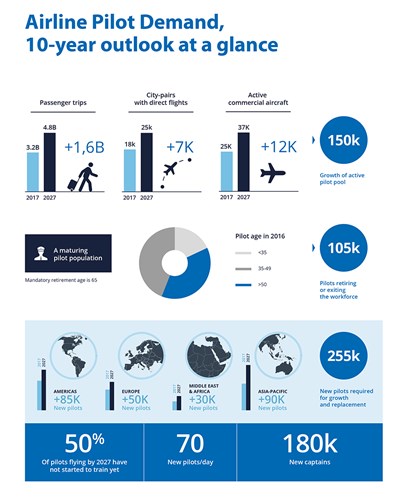
Over the past years, a number of forecasts have indicated that a world-wide pilot shortage is looming. At the RAeS Conference of September 2017 (Training for the new Millennium) the demand for airline pilots was depicted in this graph:

blog-cae-airline-pilot-demand-outlook-infographic

So we would need 70 new pilots per day to be trained – a total of 255 000 pilots required over the next nine years. For Africa and the Middle East the quoted number is more than 30 000 new pilots. The question is, where are they going to be found? I’ve discussed this before in Of Expensive Dachshunds and Landings, but my cue from Mrs Worthington is whether the prospective new replacements would be appropriately suitable, capable and safe.

In another RAeS paper, the International Pilot Training Association quotes the high cost as a barrier to entry for prospective pilots:
“The Outreach, Recruitment and Retention Workstream is targeting the pilot demand and aims to find ways of funding the ab initio training of pilots. With a demand of 600,000 pilots in the next 20 years and an average cost of £100,000 per Air Transport Pilot License, there are not enough pilots produced per year to cover both retirement and the growth of the industry”.

Also this:
“Next to the costs, there is a growing decline in the attractiveness of the pilot profession, as there are many other opportunities for young people. Women still represent only 7% of the pilot population. In China and India it is 13% but the interest of women in becoming pilots is likely still influenced by the myth that it is not a family friendly job”.

I would submit that this completely underestimates the current level of “unattractiveness” of the pilot profession.

The high cost should have been addressed long ago – a small group of airlines are now, belatedly, looking at finding ab-initio cadets to train. So yes, the cost is certainly a major barrier to entry.

To state that it is a myth that it is not family friendly is disingenious. The harsh reality is that a career as a pilot plays havoc with your family life. The fact is that pilots now no longer remain with one airline for a multi-decade career, but switch employers on average seven times during that career. This could mean moving a number of times to different continents – not necessarily what young families with children would find attractive.

That leads us then to the further problem our proverbial Mrs Worthington would face: The many thousands of new pilots required by 2027 would, of necessity, be so-called millennials – actually post-millennials, people born after the year 2000.

Millennials are a constantly connected, always mobile generation. Perhaps this could explain the decline in flying as a desirable career – aircraft (whether piloted by humans or machines) are simply another means of connecting them to the “now” experience. It is not something that warrants their total dedication and attention for many years.

I don’t believe that piloting could offer young post-millennials the instant rewards they seek – employers in other sectors would warn that millennials tend to “job-hop” very easily and regularly (for too many reasons to allow discussion here).

From the RAes Conference: “According to Rod Wren, CEO, Wings Alliance and Director Bristol Groundschool, around 50% of flight school graduates are not selected for airlines. “We need to train the right people,” he said. “Self-selection does not work. Instead, selection should be based on pilot core competences. Airlines need to engage with the flight training industry.” “We need to look at the person first before we look at their skills,” 

This is a scary point – one I’m afraid the training industry mostly overlooks to ensure a financial future. Not every bright-eyed millennial candidate arriving at your flight school would possess the competencies required to become a pilot – some should simply be pointed in another direction, rather than them wasting money on a very expensive training course.

These competencies have been well identified and documented, as set out in the Evidence Based Training (EBT) documents of ICAO, and IATA. In short, nine required competencies have been identified:

Two dealing with Flight Path Control – Manual and Automation;
Two dealing with Procedures – Knowledge and Application of Procedures;
and the remaining five all dealing with Human Factors or CRM competencies –
Communication,
Leadership & Teamwork,
Situational Awareness,
Workload Management, and
Problem Solving & Decision Making

Generalising, I understand the millennial mantra to be (remember, Mrs Worthington is all about generalisations):
(a) I am not responsible (for anything)
(b) If you hold me responsible, I will be traumatised and need counselling.
(c) My life is ruled by social media – I don’t need to learn all this stuff. If I need to know anything I simply ask Siri or Google.
(d) I live for now, your fascination with tomorrow is your problem.

This poses the problem that most of the competencies required for pilot training would not be met – unfortunately, acquiring the required level of knowledge and skill demands unwavering dedication and the acceptance of total responsibility.

Thus it would appear that the industry is soon going to run out of willing and suitable candidates.

What does that mean – what would the answer be?

The answer lies in algorithms and artificial intelligence – which already runs much of our lives (Google and your cellphone probably already know you better than you know yourself…)

In the US there is currently a concerted effort by ALPA to avoid a vote by Congress that would mandate manufacturers to research the potential for single-pilot airliners – and, by extension, pilotless airliners.

I believe that is simply delaying the inevitable.

The future of aviation is eventually going to be a pilotless environment, with autonomous aircraft whizzing your millennials’ kids between continents – and possibly between planets.

Fortunately for me, it is not likely to happen within my lifetime – oh, hang on, my cell-phone is telling me that my roster has changed, and with it my future…

So, should you put your daughter or son in the air, Mrs Worthington?

Featured image: Noel Coward and Julie Hayden, The Scoundrel.