Hindsight – The most exact science..

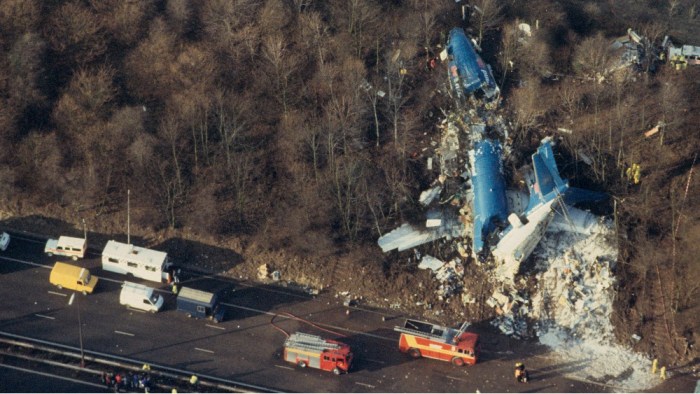
Today marks the 30th anniversary of the Kegworth air disaster – a crash which has since become a standard in CRM classes.

The story is well-known: Blade failure on the number one engine resulted in the pilots mis-diagnosing the problem, shutting down the number two engine instead. This led to the disastrous outcome, costing 47 of the 118 passengers their lives, with 74 people suffering serious injuries. 

Airways Magazine today published an Op-Ed about it, which singles out one of the major lessons learnt – because of the subsequent research into effective brace positions, safety cards and crew briefings, major changes were made to the way passengers are taught to brace for impact. (Click on the link).

However, in total more than thirty-one recommendations were made in the accident report, many of them then became binding for manufacturers and operators. 

While many factors were at play here – and we use many of them in our initial courses as examples of absent CRM – to me one of the most interesting factors is the (then) new CFM-56 engine. These engines were reasonably new in 1989, only being operated on a commercial jet for the first time in 1981. The B737-400 was also a new aircraft, first operated in September 1988. The accident airframe, G-OBME, was only delivered to British Midlands in October 1988 – two-and-a-half months before the crash. 

The CFM-56 used on the -400 was an uprated version of the engine used on the earlier -300 variant. (The -300 was launched in 1984). 

To uprate the -300 engine from 20 000 pounds of thrust to the 23 500 required for the slightly larger -400 required only an electronic chip to increase the N1 (RPM). However, this modification was never tested in the air, only on a test rig, before being certified for use on the -400. Unknown to the manufacturer and operators, blade stall became a problem above 10 000 feet and this was what eventually resulted in the blade failure on the accident aircraft.

The problem was easily rectified, and the CFM-56 is now probably one of the most reliable engines ever built. 

However, it took an accident to lead to this improvement.

Too often this is the case. We learn from each accident and try to understand all the factors involved – in an attempt to avoid similar accidents occurring. But all to soon, it would appear, we become complacent about those lessons learnt – and only yet another crash leads us to question whether we’ve actually learnt anything at all!

Debris from the crashed B738-Max being recovered.

Take, for instance, the recent crash of a LionAir B738-Max – to my mind also caused by a design change which caught everyone by surprise. (Although the previous crew to fly the doomed aircraft experienced the same problem, they had the resilience to recover the aircraft by reverting to good old manual flight). However, without the knowledge about the potential problems associated with the MCAS system, the accident crew were clearly confused by the malfunctioning automation and were unable to regain control. 

To my knowledge the British Midland crews had been operating B737-200 aircraft before, and only attended classroom differences training before flying the -400. As someone who has flown many of the variants, ranging from the 737-Basic to the B738, I know that the only way to convert from the -200 to the -400 would be proper simulator training – they are quite different aircraft. This lack of training could well have been another link in the Kegworth accident chain.

And now pilots were once again expected to convert to a new B737 model with a little classroom video and a CBT test. 

It would appear to me that we’re not inventing new ways to crash, we’re simply repeating the same mistakes over again.

In the same breath I must add that we have certainly come a long way since the Kegworth disaster. The recently published accident statistics bear testimony to the fact we are on a sustained downward trend, and flying is in fact safer than ever.

It’s just such a pity that we always have to remember accidents like Kegworth, to remind ourselves of the potential for disaster.

 

Machines or Pilots?

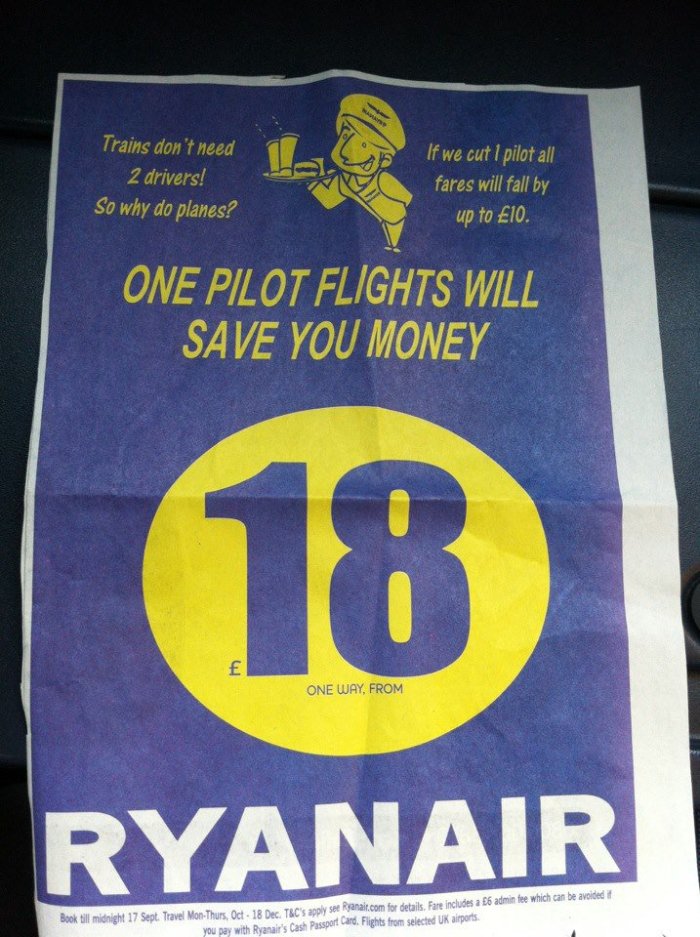
I don’t know how genuine the featured Ryanair advert is – it could well be “fake news” – but it does fit the cost-cutting image of Michael O’Leary! He has long advocated that he wanted single-pilot airliners by 2020, as well as advocating “stand-up” cabins (no seats) and passengers paying to use the toilets. A lot of this is usually dismissed as publicity stunts, but his recent stand-off with pilot unions clearly indicates that a no-pilot airline would be his ideal. It is quite enlightening to hear him contradicting himself about the importance of pilots: https://youtu.be/fSmnHbGMMok

He is not alone.

Research into autonomous flight is well underway. Boeing’s research has been underway since 2013 and Airbus has been working with French aerospace research company Onera and avionics manufacturer Thales for a number of years now.

The financial impetus to move to pilotless aircraft is immense – analysts see a potential profit opportunity worth about $35 billion for the aviation and aerospace manufacturing sectors. Read more here: http://aviationweek.com/commercial-aviation/pilotless-commercial-aircraft-follow-money

Artificial Intelligence has already surpassed human ability – just research Google’s AlphaZero programme, which defeated Stockfish 8, a programme capable of calculating 70 million chess positions per second. AlphaZero, though, was not programmed or taught any chess at all. It taught itself to play chess in just four hours and then beat the 2016 World Champion (Stockfish 8) on the 7th December 2017. Yes – machines have long surpassed humans at playing chess, a game which for centuries was considered one of the greatest achievements of human intelligence.

We as pilots are inevitably quick to point out that no machine can match our intuition achieved through training and experience – forgetting that “intuition” is only pattern matching, a skill which algorithms have proved to be much faster and more consistent at.

We’re also very aware of passengers preferring two (or more) pilots in the cockpit – but younger people and new generations will be quicker on the uptake and may accept a no-pilot environment more easily. Just think of the many cockpit jobs which have become redundant over the past few decades – radio operators, navigators, flight engineers – all once essential. And now? Could pilots be next?

While I submit that we are inevitably on the road to autonomous aircraft, it will in all probability not happen very soon.

For instance, Thales is working on “genetic algorithms,” the fittest of which survive. Several variants of an algorithm are combined. The resulting second-generation algorithms are compared by having them solve a problem. Those most effective are kept and combined to create a third generation and so on. So the ninth or tenth generation will be significantly better than the first. The problem, the way I understand it, is that the algorithms’ solutions become unpredictable – not wrong, but unpredictable. And in aviation we need predictability – you cannot certify a component with unpredictable characteristics. We need to understand “why” the algorithm arrived at a particular solution.

Boeing has just learnt this lesson with the MCAS system on the B737-Max. While the designing engineers thought they understood the “hidden” system and its implications, the human-machine interface failed because of the failure to include it in pilots’ conversion training. The pilots were simply not expecting the excessive nose-down trim demanded by the system, due to the FMC being confused by a faulty AOA sensor. And here we’re not even in autonomous territory yet, because the pilot can still disengage the electric trim and revert to good old manual flight.

So while the MCAS of the Max can still be understood and be “predictable” – once we hand over complete control to the aircraft, it has to be completely predictable.

That “predictability” appears to be some way off – “If we cannot explain what the system does, we will have a hard time obtaining a certification,” said Virginie Wiels, Onera’s director of information processing and systems. Significant progress can be expected by 2021, according to Marko Erman, Thales’ chief technical officer. But Wiels does not foresee any application on the flight deck in the next 10 years.”

That would imply that the possibility exists to have pilotless aircraft airborne by 2030!

So O’Leary may have to wait a few years to see his dreams come true – until then, I’m afraid we need to understand the immense pressures pilots experience in a very demanding environment – one where their crucial role is progressively being denigrated and misunderstood.


Don’t put your daughter on the stage, Mrs Worthington…

Noel Coward wrote this song in 1935. While there are a few theories about what induced him to write it, the gist of the lyrics is a list of reasons why Mrs Worthington’s daughter should not be allowed near the stage. Whether intended as a genuine rebuke or simply a bit of (very tongue-in-cheek British) humour, I’m appropriating it today for another ditty (you can use the original music, should you please).

Actually, it won’t be a ditty – my musical ability lags too far behind. But the revised title is:

Do or don’t you put your daughter or son in the air, Mrs Worthington?

It is a topic I’ve briefly touched on before, in 2016 and the Future for Pilots. The situation (halfway through 2018) is much the same, but a few pointers need discussion.

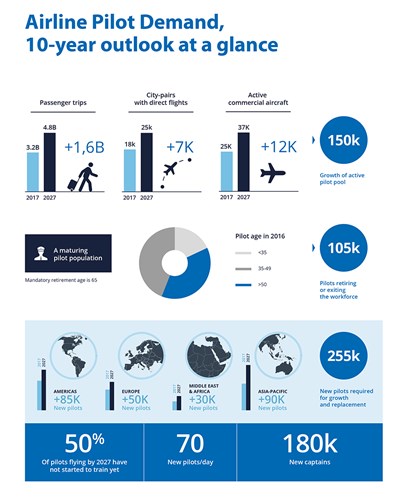
Over the past years, a number of forecasts have indicated that a world-wide pilot shortage is looming. At the RAeS Conference of September 2017 (Training for the new Millennium) the demand for airline pilots was depicted in this graph:

blog-cae-airline-pilot-demand-outlook-infographic

So we would need 70 new pilots per day to be trained – a total of 255 000 pilots required over the next nine years. For Africa and the Middle East the quoted number is more than 30 000 new pilots. The question is, where are they going to be found? I’ve discussed this before in Of Expensive Dachshunds and Landings, but my cue from Mrs Worthington is whether the prospective new replacements would be appropriately suitable, capable and safe.

In another RAeS paper, the International Pilot Training Association quotes the high cost as a barrier to entry for prospective pilots:
“The Outreach, Recruitment and Retention Workstream is targeting the pilot demand and aims to find ways of funding the ab initio training of pilots. With a demand of 600,000 pilots in the next 20 years and an average cost of £100,000 per Air Transport Pilot License, there are not enough pilots produced per year to cover both retirement and the growth of the industry”.

Also this:
“Next to the costs, there is a growing decline in the attractiveness of the pilot profession, as there are many other opportunities for young people. Women still represent only 7% of the pilot population. In China and India it is 13% but the interest of women in becoming pilots is likely still influenced by the myth that it is not a family friendly job”.

I would submit that this completely underestimates the current level of “unattractiveness” of the pilot profession.

The high cost should have been addressed long ago – a small group of airlines are now, belatedly, looking at finding ab-initio cadets to train. So yes, the cost is certainly a major barrier to entry.

To state that it is a myth that it is not family friendly is disingenious. The harsh reality is that a career as a pilot plays havoc with your family life. The fact is that pilots now no longer remain with one airline for a multi-decade career, but switch employers on average seven times during that career. This could mean moving a number of times to different continents – not necessarily what young families with children would find attractive.

That leads us then to the further problem our proverbial Mrs Worthington would face: The many thousands of new pilots required by 2027 would, of necessity, be so-called millennials – actually post-millennials, people born after the year 2000.

Millennials are a constantly connected, always mobile generation. Perhaps this could explain the decline in flying as a desirable career – aircraft (whether piloted by humans or machines) are simply another means of connecting them to the “now” experience. It is not something that warrants their total dedication and attention for many years.

I don’t believe that piloting could offer young post-millennials the instant rewards they seek – employers in other sectors would warn that millennials tend to “job-hop” very easily and regularly (for too many reasons to allow discussion here).

From the RAes Conference: “According to Rod Wren, CEO, Wings Alliance and Director Bristol Groundschool, around 50% of flight school graduates are not selected for airlines. “We need to train the right people,” he said. “Self-selection does not work. Instead, selection should be based on pilot core competences. Airlines need to engage with the flight training industry.” “We need to look at the person first before we look at their skills,” 

This is a scary point – one I’m afraid the training industry mostly overlooks to ensure a financial future. Not every bright-eyed millennial candidate arriving at your flight school would possess the competencies required to become a pilot – some should simply be pointed in another direction, rather than them wasting money on a very expensive training course.

These competencies have been well identified and documented, as set out in the Evidence Based Training (EBT) documents of ICAO, and IATA. In short, nine required competencies have been identified:

Two dealing with Flight Path Control – Manual and Automation;
Two dealing with Procedures – Knowledge and Application of Procedures;
and the remaining five all dealing with Human Factors or CRM competencies –
Communication,
Leadership & Teamwork,
Situational Awareness,
Workload Management, and
Problem Solving & Decision Making

Generalising, I understand the millennial mantra to be (remember, Mrs Worthington is all about generalisations):
(a) I am not responsible (for anything)
(b) If you hold me responsible, I will be traumatised and need counselling.
(c) My life is ruled by social media – I don’t need to learn all this stuff. If I need to know anything I simply ask Siri or Google.
(d) I live for now, your fascination with tomorrow is your problem.

This poses the problem that most of the competencies required for pilot training would not be met – unfortunately, acquiring the required level of knowledge and skill demands unwavering dedication and the acceptance of total responsibility.

Thus it would appear that the industry is soon going to run out of willing and suitable candidates.

What does that mean – what would the answer be?

The answer lies in algorithms and artificial intelligence – which already runs much of our lives (Google and your cellphone probably already know you better than you know yourself…)

In the US there is currently a concerted effort by ALPA to avoid a vote by Congress that would mandate manufacturers to research the potential for single-pilot airliners – and, by extension, pilotless airliners.

I believe that is simply delaying the inevitable.

The future of aviation is eventually going to be a pilotless environment, with autonomous aircraft whizzing your millennials’ kids between continents – and possibly between planets.

Fortunately for me, it is not likely to happen within my lifetime – oh, hang on, my cell-phone is telling me that my roster has changed, and with it my future…

So, should you put your daughter or son in the air, Mrs Worthington?

Featured image: Noel Coward and Julie Hayden, The Scoundrel.


(Dis)Service Animals?

Serious animal lovers – my family and I. We currently have a rescue dog, who has turned out to be the most intelligent and lovable animal. I have to state upfront that, having grown up with family pets and with some farm experience as well, I do actually know something about animals.

Malaika
Enjoying the sun on the boardwalk. 

One of the less enjoyable parts of my job is to sign the NOTOCs (Notification To Captain) for animals carried on board our aircraft. Less enjoyable, as I often see the distress these animals suffer. More about that later.

Firstly, let’s discuss the merits of carrying animals in the cabin – a hot topic on social media, where (in particular) some US airlines are taking serious flak for faux-pas with “service animals”. The use of inverted commas is deliberate, as many of these animals appear to simply be badly behaved pets owned by equally badly behaved passengers. Apparently US airlines opened themselves to abuse by allowing “service animals” and “emotional support animals” indiscriminately into cabins – a trend they are now attempting to reverse by imposing some restrictions.

Mostly it would appear that US passengers are simply trying to avoid paying for their pets’ transport. Animals are apparently carried free of charge in cabins – probably regarded as carry-on luggage!

But this has come back to bite some airlines (pun intended), where dogs have attacked other passengers and animals caused havoc in aircraft cabins, with lawsuits now the order of the day.

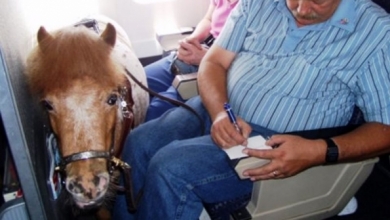
To my mind, putting an untrained animal in a stressful situation among strangers in an aircraft cabin is tantamount to cruelty. That’s apart from it being discourteous and possibly dangerous to other passengers. And I am sorry, but if you need a peacock or a pony as an “emotional support animal” on an aircraft, perhaps your psychologist should have advised you against using any form of public transport.

Fortunately, the airline I fly for has strict rules about service animals in our cabins. In fact no livestock is allowed, with service dogs being the only exception. Only dogs trained (or being trained) by the Guide Dog Association of SA and other organisations affiliated with Assistance Dogs International and the International Guide Dog Federation can be accepted as “service dogs”. Passengers need to complete assessment and declaration forms, signed by a medical practitioner and provide proof from the aforementioned organisations that the dog has received the required functional and familiarisation training – all this well in advance of travelling.

In my experience this works extremely well. We often have properly certified service dogs on board and they behave impeccably, with no or minimal disturbance to other passengers.

Any other livestock must be carried in specifically designed containers in the forward hold. (Referring now specifically to the airline I fly for and the B737). IATA Live Animals Regulations apply. By the way, these regulations do not recommend sedation, except under certain conditions and when carried out under veterinarian direction.

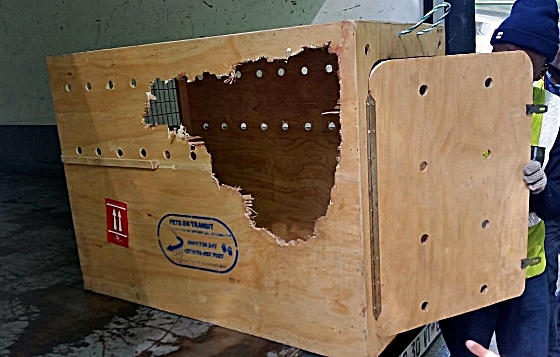
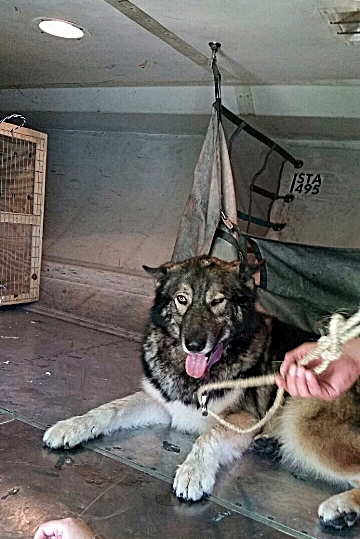
I mentioned earlier the distress these animals suffer – this I’ve seen first-hand many times. I don’t know about fish, snakes or birds – they’re a bit difficult to understand (and we often carry those). But dogs, cats, monkeys and other pets often appear frightened and very stressed. One big Alasatian became so stressed that he chewed through his container and was found running around on the luggage in the hold after we had landed.

IMG-20150401-WA0002-crop
Alsatian chewed his way out during a flight of under two hours.

IMG-20150401-WA0001-crop
Eventually caught by a professional, still aggressive to anyone coming close.

That is clearly not ideal and perhaps indicates how, despite our best intentions, these animals suffer when forced to travel.

Now I know that the airlines, freight forwarders, pet shops and vets make good money from the transport of livestock – it’s just that I would personally not endorse the endeavour. I’ve seen too much trauma in the front hold during my many pre-flight walkaround inspections.

And as for animals in the cabin – don’t even go there!

(Featured Image by JBR Ranch via Aviation Week; Other images by the author).


Ex Libris

Pilots don’t read very much.

Just ask any chief pilot or flight ops head and they’ll tell you that pilots don’t read NOTAMS or memos – or e-mails, for that matter!

However, when it comes to recreational reading, it may be a different story – certainly in my case.

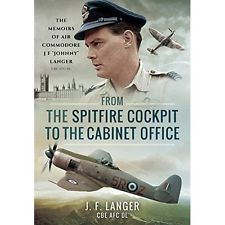
I have a veritable library of “flying” books, ranging from the whole set of Ernest K Gann’s books, to many biographies and histories. I must have indicated as much somewhere in one of my posts, as about two years ago Pen and Sword contacted me to suggest that I should perhaps read some of their publications for possible review. Their logo includes the heading “Bringing you Closer to the Past” – which explains their catalogues of special interest publications. Long story short – after battling the SA postal service, I finally received From the Spitfire Cockpit to the Cabinet Office.

A typical Pen and Sword offering, this is the memoirs of the late Air Commodore JF “Johnny” Langer, CBE AFC DL. A career Royal Air Force pilot, he joined the RAF towards the end of WW2 and, as pilots could wait for up to a year for a flying posting , volunteered to fly gliders in India, preparing for airborne assaults in Burma. Later in his career he would return to the far East in various postings – the final time overseeing the creation of the Singapore Air Force.

JF Langer book

Post war he served on fighters, first in Germany and later commanding No 43 (F) Squadron – the famous “Fighting Cocks” at Leuchars. As a Group Captain he commanded RAF Valley and later became Director of Flying Training. In this position he set up the original Red Arrows in Gnats and saw their transition onto Hawks.  Of particular interest is his co-chairing of the multi-national committee to bring the Tornado into service, and his responsibilities in introducing the Hawk trainer into the RAF (and the US Navy).

Retiring after 37 years of RAF service, he served as Civil Aviation Security Adviser to the UK Government.

That’s the very short summary.

The book itself is typical of a self-written memoir, full of minutiae and sometimes quite long-winded. Bearing in mind that he wrote these memories down over three years while already in his eighties, it is easier to understand where the sometimes quaint and often almost archaic descriptions come from. Be prepared to decipher many bits of “RAF-speak” and a military attitude to most situations described – the writing often reminds one of a staff paper, but at least with some typically dry British humour thrown in here and there! At times he almost touches on ribaldry (he quite bluntly lists some of his youthful sexual conquests), but constantly one senses an understated but very detailed approach to the typical peace-time career of an air force pilot. This said, he is never shy to make mention of some of his achievements as a pilot and sportsman!

One issue, about which he minces no words, is his dislike of military personnel who did not meet his demanding expectations. He is particularly scathing about some senior officers whom he regarded as obstructive to his career advancement. His aim was to end his career as an Air Vice Marshall (AVM) – something he did not achieve.

Air Commodore Langer remained active in retirement, still acting as a tour guide at Kelmscott Manor in the Cotswolds well into his eighties.

From the Spitfire Cockpit to the Cabinet Office covers a period from the end of WW2 to the first military jets, through the Cold War and the Victor series, to the modern fast jets and the security threats to modern airliners. If military and aviation history is your cup of tea – then you will thoroughly enjoy this book!

Featured Image: World of Aircraft Design; WordPress.com.