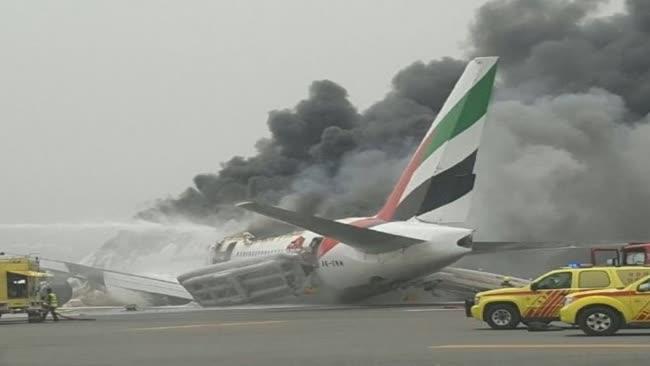
Yesterday we witnessed the crash of an Emirates B773 at Dubai. I use the word “witnessed” as we may just as well have been eyewitnesses, what with visuals instantly available on the major TV channels, uploaded from social media. Had it happened a few years ago, we would simply not have had access to these dramatic visuals captured by actual eyewitnesses.
What I find disturbing though, are the visuals recorded by passengers during the actual evacuation of EK521, with a life-threatening emergency in full swing: Pax Evacuation EK521
During many previous aircraft emergencies we’ve witnessed this behaviour before: Cell’phones on, visuals recorded and instantly shared on social media. Allow me to be blunt: This type of behaviour deserves a Darwin Award for Deadly Stupidity!
It would appear that in aviation we’re not alone in this:
Pic: socialsmiling.com
So what allows us to exhibit this kind of stupidity? What level of intelligence would allow a normally stable individual to jeopardize not only his/her own life, but the lives of others as well?
I can only assume that it is the same level of intelligence which would allow passengers to blatantly disregard the safety regulations, ignore safety briefings and refuse to obey lawful instructions regarding electronic devices.
The bottom line is that anything which could distract one during an emergency should be avoided at all costs – hence the announcement by cabin crew regarding no cell’phones or headphones before departure or arrival. When the fire is at your heels and the smoke is choking you, that is not the time to worry about your branded hand luggage or your personal effects – that is when saving lives should be your one and only concern.
I know that passenger safety is our single-minded concern. As professional air crew we’ll do everything possible to ensure that, but passengers also have a role to play in their own safety!
However, it would appear that any commonsense, reason and responsibility is zipped up and stowed in the luggage when passengers check in….
The best-laid schemes o’ mice an’ men Gang aft agley, An’ lae’e us nought but grief an’ pain, For promis’d joy! Robert Burns – From: ” To a Mouse, on turning up in her nest with the plough”.
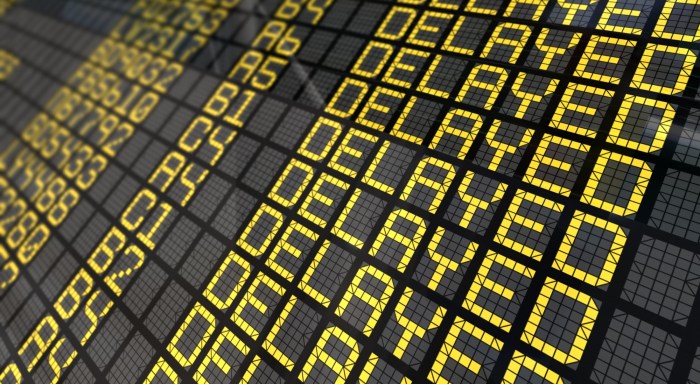
We’re running late.
In fact, we haven’t even signed on yet – my four sectors rostered for today have been delayed – and I’m already working on what apologies we’ll have to come up with to calm our disgruntled passengers….
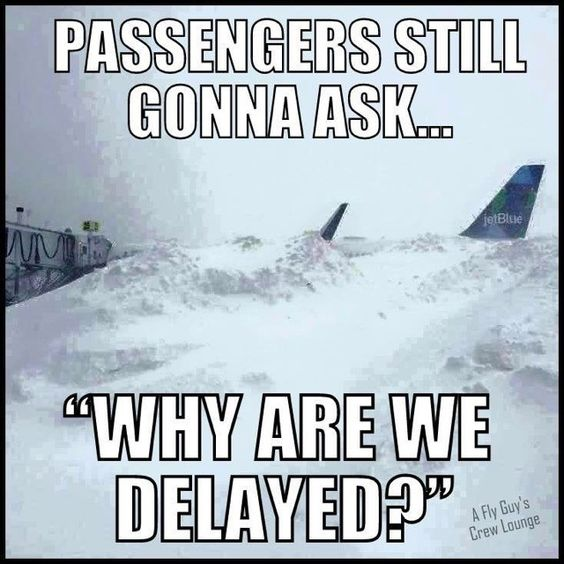
The reason today is the knock-on effect of the icy conditions at another airport this morning – the early flights had to wait for the sun to melt ice off the wings. Fortunately we don’t have snowstorms (as in the picture above) in South Africa, but we do find temperatures falling to below zero in winter. Add a little moisture and then you could find contamination on the wings – which, if untreated, we well know the results of. Air Florida Flight 90 is but one example. As we don’t suffer from surface icing too often, we do not have de-icing facilities at any South African airports. Sunshine is our only salvation!
So here we sit after a night stop, waiting for our delayed aircraft to arrive to continue our (delayed) eight-sector pairing.
But that is scant comfort for our passengers who feel that they are entitled to an on-time departure and arrival.
Weather is only one of the many reasons leading to flight delays. In SA thunderstorms are usually the culprits during summer; sometimes driving rain or fog results in go-arounds and diversions from airports with only CAT I or visual approaches. Many times the crosswind component is simply out of limits, ruling out an approach or necessitating a go-around.
From our side its often because of an aircraft developing a technical problem, which, if it can be repaired on the line could result in a short delay of up to an hour. Some snags take more time, especially if specific spares or tools are required – if the aircraft is grounded, schedules have to be adjusted to find other aircraft to pick up the slack, often resulting in all of us kicking our heels for frustrating periods of time.
Often such delays can lead to crews running out of flight and duty time, which legally necessitates later sign-on times for those who night stop at out stations. You should hear the chirps from furious passengers when we finally show up to operate such a flight – very thick skins are required! Explaining the safety aspect usually does not help much – I sometimes get the impression that passengers would rather depart unsafely, as long as it’s on time..
Sometimes the passengers are to blame – my pet hate is passengers who check in (with luggage) and then disappear between the counters and the gates. Its like socks – where the hell do they get to? Now we have to search for their loaded bags, inevitably the very last ones to be found.
Arriving with too many bags also delays us, as those simply cannot fit in a full cabin and have to be carried downstairs to be loaded in the hold (usually after a heated argument..)
Some passengers are like hens arranging nests – why can’t they simply move in, and sit down? While passengers are standing around, going to the toilet or repacking their cases, we cannot close the doors. Late yet again.
Many other reasons can be trotted out for delays. The bottom line, however, is that a delay is only that: A delay. It is not a disaster and it is not the end of the world!
Our airline aims for a minimum target of 85% on-time departures (on time is defined as leaving within 15 minutes of the scheduled departure time) and has achieved that for six consecutive months now.
After all – A safe flight and safely arriving at your intended destination is more important than fretting about a delay.
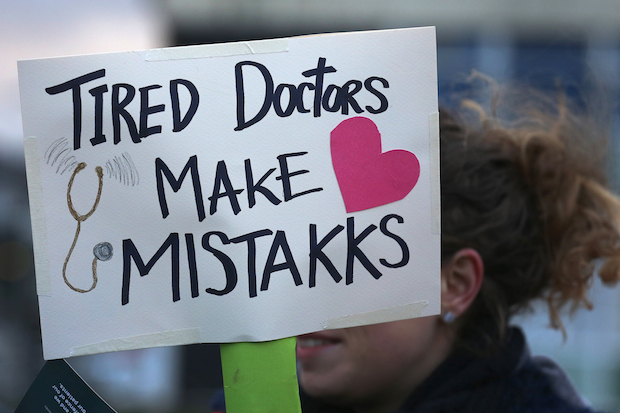
Last week a medical professional had a letter published in the Cape Times. In this he questioned the sanity of rules which allow for doctors working shifts of 30 hours plus, after the death of a young doctor in a fatigue-related crash. (Read the letter here).
Dr John Roos is a passionate advocate of CRM for the medical profession – I have worked with him at the recent ICEM (International Conference for Emergency Medicine) in Cape Town, where we co-presented an introductory workshop on CRM. Just from my anecdotal experience of the medical environment I am aware of the extreme demands on these professionals. Suffice to mention that medical malpractice is now the third largest cause of preventable deaths in the USA – in fact the statistics bear out the fact that you are much more likely to die unnecessarily in hospital than in an airliner:
According to the Western Cape Department of Health the regulations approved by the HPCSA (Health Professionals Council of SA) do allow for medical professionals to work shifts of up to 30 hours. (Article here).
Well, I am simply astonished at the Neanderthal system employed in our healthcare!
In Aviation we have been aware of the problem for decades. However, the fact that fatigue is a difficult concept to quantify has also been recognised for years. At a 2006 Paris conference on Aviation Safety hosted by the Flight Safety Foundation, IATA and the International Federation of Airworthiness papers presented pointed out how complex issues affecting pilot fatigue were.
Despite our best efforts at improving aviation safety, we are not out of the woods yet. Flight Global conducted a survey of Aviation Professionals a few years ago (Survey Results) and top of the list was fatigue among safety critical staff such as pilots, engineers and ATC’s.
This despite the fact that maximum hours for flight and duty are clearly defined and rigorously adhered to.
The next step is the legally required implementation of FRM and FRMS programmes, where airlines are required to actively monitor and manage pilots’ fatigue. This would imply identifying potentially fatiguing pairings and reporting on fatigue experiences.
Surely medical personnel must be involved in determining these parameters – yet they seem themselves impervious to the idea that doctors could possibly become fatigued.
So, I would rather fly than take the risk of being assessed or operated on by a fatigued medical practitioner! The stats bear me out.
If you want to build a ship, don’t drum up the men to gather wood, divide the work and give orders. Instead, teach them to yearn for the vast and endless sea. Antoine de St. Exupery – The Wisdom of the Sands
A few weeks ago I was interviewed for a newspaper article and the old question came up again: “Why do you fly?”
I gave the standard vague answer about the different dimensions, the challenges, the joys – and that I simply have to fly.
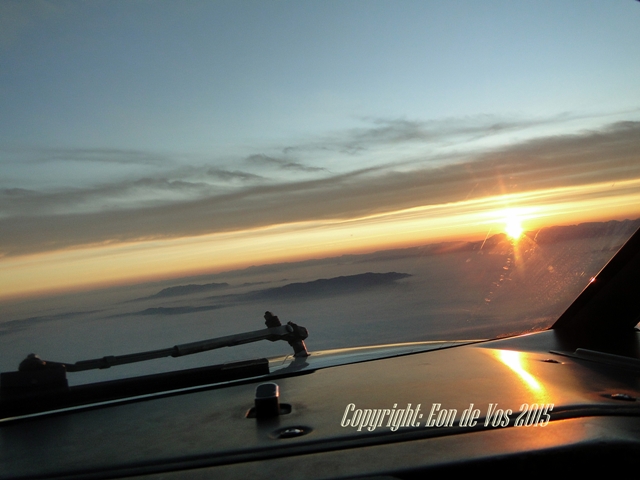
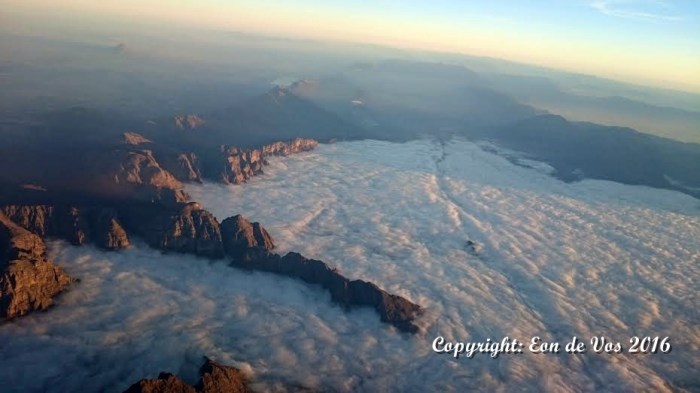
Then, during an early morning departure out of Cape Town the answer came to me, when both the FO and I grabbed our cameras and snapped away to capture the beauty of the early morning fog reflecting the flaming hues, with the stark mountaintops protruding through the low cotton-cloud to be bathed in brilliant sunshine.
Just another departure, another sunrise – but we were captured, captured yet again by the intense beauty. This coupled to the sense of control, balance, power and achievement – and then I realised: We do what we do because it sets us apart. Its that constant yearning for the next horison. Or to paraphrase St. Exupery – that yearning for the vast and endless sky.
I don’t think an auditor would snap pictures of numbers to share on social media – “Hey, look at these books I’m doing today!” Or a lawyer dealing with yet another divorce, or a doctor dealing with another case of the common flu….
People in other occupations share their holiday pictures – “Hey, here we are at this exotic location! Having a great time! Cost a fortune!”
We do that too, but it is our work and our workplace which captures the imagination. We just snap an ordinary day at work and people react in amazement – “Stunning, you’re so lucky…”
That’s what sets us apart – we’re lucky. We enjoy what we do, we love what we do and we would not want to do anything else.
I know it’s not always a bed of roses. Sometimes life’s curved balls make different demands on us – but for the instinctive pilot giving up on flying is not a consideration. Inevitable it may eventually become, but the longer we can postpone the giving up, the loss of license, the retirement, the better.
Because there is always another horizon to cross, another aircraft to fly, another exotic memory to add!
“It seems very pretty,” she said when she had finished it, “but it’s rather hard to understand!” (You see she didn’t like to confess, even to herself, that she couldn’t make it out at all.)
– From Through the Looking Glass and what Alice found There, by Lewis Carroll.
Earlier today I had a discussion with a journalist regarding a TV programme about decompression events in aircraft, for which he had done the research. This leads me to my blog’s musings for today: What influence does the crew have on passengers’ experience and their recollections after an incident? We’re not discussing serious accidents here, only the run-of-the-mill events such as go-arounds, diversions, technical problems and, yes – pressurisation problems.
“This is your captain speaking…”
You would hear these words on almost every commercial flight. It is probably the most quoted sentence when passengers discuss their experiences in the air. Yet very few people would be able to tell you what the captain, or the cabin crew for that matter, had actually said. Not always because the announcements sounded like some comedian’s rip off – simply because people do not pay attention.
I’ve discussed passengers’ behaviour during emergencies before (see my previous post Evacuate, Evacuate! Are you ready?) as well as the power of the media in Good News vs Bad News.
What concerns me here is the widely disparate perceptions passengers report after an incident. “Report” is the correct verb here – anyone with a cellphone becomes an instant reporter and social media allow immediate “reports” on events as they unfold.
Unfortunately, most passengers are not experts in matters aviation and, much like Alice we don’t want to confess that we simply have not the faintest idea of what is happening, has just happened or had happened. However, cellphones allow us to become instant and expert commentators.
Phrases such as “near death experience”, “hysterical cabin crew” or “terrified passengers” abound. Snippets of accurate, factual information are few and far between. “Facts” often prove to be completely wrong perceptions – in one recent event a passenger commented that “the person who tweeted this could not have been on the same aircraft!”.
The dangerous reality is that a perfectly safe airline can have its reputation in tatters and face bankruptcy as a result of 140 instant characters.
Most airlines, like most businesses have an online presence and a department dedicated to following social media. They hope to catch the complaints and negative comments, attempting to counter them – essentially damage control. Unfortunately modern humans have an incredibly short attention span and by the time your positive reply hits social media, we are already onto the next 140 characters of interest.
During the QF32 emergency social media declared that the A380 had crashed, even while Captain De Crespigny and his crew were working the problem and getting their passengers back safely. Fortunately the hysteria calmed down once the facts became clear.
Have a look at this YouTube Video clip from News24:
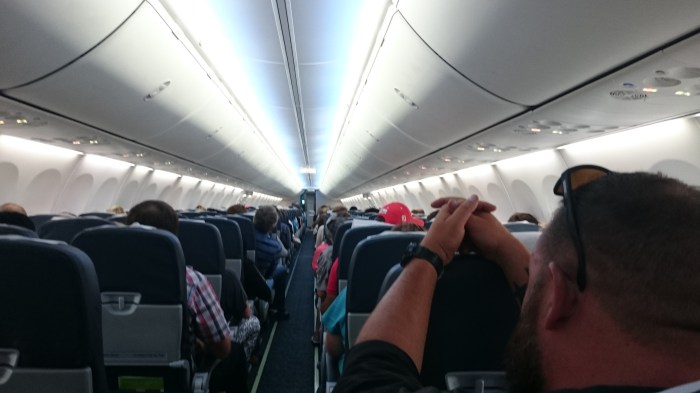
Despite the headline, I think the passengers do not look too concerned – very few are wearing their oxygen masks, most have the time and presence of mind to turn their cellphones on to film the goings-on. (Just joking – they were on anyway…) There is the sound of a baby crying, understandable as infants cannot equalise quickly and their ears would hurt with any pressure differential.
So where did the reports of “terrified” passengers originate?
Other social media reports indicated trauma and high drama – clearly not everyone was as composed as the people visible in this clip. I saw reports of “oxygen not flowing” – probably from those who forgot the briefing to give a tug to start it flowing.
Which brings me to the role of the crew – all professionals, all trained to deal with these situations. However, although most airlines would provide standard announcements for various events – some pilots and cabin crew are simply better able to communicate and calm frayed nerves.
When United 232 lost all hydraulics and all controls when the no. 2 engine failed catastrophically over Iowa, passengers spoke afterwards about Captain Al Haynes being “firm, but soothing” while informing them via the PA system.
Similar complimentary comments were made about the way the crew of QF32 handled the PA announcements.
QF 32 (Pic: criticaluncertainties.com)
As pilots we make decisions in difficult situations based on the old A-N-C acronym – Aviate, Navigate, Communicate. Our primary task is to fly the aircraft, whatever the situation. Once the flight path is under control, we need to fly it somewhere – the navigate bit – whether it be to a diversion airfield or to a ditching. Then we tell people what we are doing – ATC, our crew, and when time allows, our passengers.
It would appear that we should improve that last little bit – keeping passengers informed and comforted could avoid most of the negative and destructive social media rants.
In fact, after Captain De Crespigny had debriefed the passengers of QF32, TV crews were eager to record the dramatic stories of survival which these passengers surely had to tell – to their dismay, most of the passengers had no complaints and only praise for the crew.
Pilots train exhaustively for any possible mishap. Dealing with incidents and problems is the easy part – how you address the passengers when they feel like Alice is a major challenge. However, allowing them to make sense of our “inverted world”, reading in reverse in the mirror could allow them to slay their Jabberwocks and turn the negative experiences and comments into compliments.





 Hangar Talk with Eon
You must be logged in to post a comment.