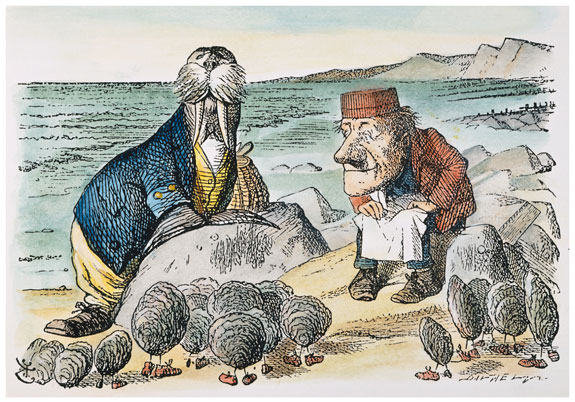
The time has come,' the Walrus said,
To talk of many things:
Of shoes — and ships — and sealing-wax —
Of cabbages — and kings —
And why the sea is boiling hot —
And whether pigs have wings.'
        (The Walrus and the Carpenter – Lewis Carroll)
Life is all about choices – so the old cliché goes. One could choose life as a self-determined destiny, or as a predestined, no-control condition – or as a condition and conclusion decided by others. This external control choice is what the poor oysters who ended up on the buttered bread had exercised. (Carroll’s poem, from “Through the Looking Glass” speaks about a walrus and a carpenter who trick innocent young oysters and eat them after a walk on the seashore).
However, the human condition is inexorably linked to the inevitable passage of time. One of the benefits of this countdown, is that with age comes experience and (hopefully) some wisdom. In Carroll’s poem the eldest oyster decided not to follow, while the younger ones went off to meet their doom…
So, how important is age? Popular literature portrays age as “just a number”, but in flying, unlike most other occupations, the decision about when you should be put out to pasture is not your own. A preset age, arbitrarily determined by regulators (presumably with some input from actuaries quoting statistics) renders one quite suddenly incapable of commanding an airliner. This after a pilot has twice a year, for many years, proved his or her capability to regulator and airline, flew the line without mishap and could still pass a Class 1 medical without any problems.
However, where the young oysters could not foresee the end, at least pilots are pre-warned and thus prepared for the event.
Just not this time…
Suffice to say that COVID-19 has decimated the aviation industry, and all too many articles have already been written about it.
Qantas chief executive Alan Joyce described it as ‘the worst crisis the aviation industry has gone through’. United Airlines chief executive Oscar Munoz has called it ‘the most disruptive global crisis in the history of aviation’.
Around the world, 22 major airlines have gone into bankruptcy or administration. Manufacturers and operators including Airbus, Rolls-Royce, British Airways, Ryanair and Qantas announced job cuts totalling tens of thousands. Fortune magazine estimated 670,000 aviation jobs had disappeared by June 2020. With 92 per cent of its fleet on the ground, Lufthansa put 80,000 of its 130,000 workforce on shortened hours.
The International Air Transport Association (IATA) says air transport is likely to witness a dive in revenue of 55 per cent in 2020 compared to 2019. IATA expects the resulting slump to lead to 32 million job losses
Worldwide, many pilots are retiring early or accepting severance packages. Many more are simply leaving the industry, possibly never to return – pilots possess many interchangeable skills which could be used in miriads of other fields.
Some have had the misfortune of living with no pay during lockdown, now possibly returning to fly a reduced schedule for a shrinking airline and with severely reduced remuneration packages.
Others suddenly found themselves out in the cold – having reached that disqualifying age during the pandemic. Months without income suddenly followed by “retirement”.
“Not too bad”, I hear you say – and you’re correct. It is indeed better than many others’ circumstances. But is is still sad for senior pilots not to have any say in the matter, not to have had the planned run-up to the final flight and the goodbyes.
For those of that certain age it becomes a case of dealing with retirement investments and financial advisors – who all resemble the walrus and the carpenter – presenting a rosy picture while planning to have you on buttered bread…
The eldest Oyster looked at him,
But never a word he said;
The eldest Oyster winked his eye,
And shook his heavy head—
Meaning to say he did not choose
To leave the oyster-bed.
Forty years of flying have taught me this: Given the time and thought required, the storm will clear and the emergency can be resolved. And it requires the patience and resilience of the eldest oyster.
Just like this oyster – who remained put – the secret is to await the next high tide. That high tide will inevitably arrive, recede and arrive again. With it will come the vision of fresh waves to wash away the grit and sand, providing new nutrients and yet another opportunity to grow.
The time has come, to talk of many things… and about where to next.
 Hangar Talk with Eon